Principles of the Remuneration Policy
Our Policy is founded on clear and shared principles that guide compensation programmes and the actions that ensue

We are convinced that by drawing inspiration from these principles, our remuneration systems can be a key element for attracting, developing and retaining talent and key people with critical skills and high potential as well as engaging all employees, thereby promoting a correct approach in aligning their performance with Company results and building the premises for solid and sustainable results over time.
Equity and Consistency
- The Remuneration is set in line with local laws and regulations, the provisions of national and Company collective agreements, and must be fair with respect to the duties and responsibilities assigned to the person, the roles held, and the skills and capabilities demonstrated;
- Generali is committed to promoting equal treatment and pay equity across genders fostering a culture based on meritocracy and equity, where equal work or work of equal value are matched by equal pay;
- Generali promotes fair remuneration practices, ensuring employees’ compensation can meet their needs adequately in light of national economic and social conditions;
- The principles of equity and consistency, with respect to position and task performed, shape the composition of remuneration packages, defined by calibrating the different forms of remuneration, also taking into account best market practices.
Alignment with the Strategy and Long-Term Sustainable Value Creation
- Remuneration structures, calibrated based on the relevance of the role, are a fundamental tool for aligning our people’s conduct with corporate strategies to support strategic achievement of financial (risk-adjusted) and non-financial results (including sustainability);
- Remuneration practices are strategically designed, and calibrated based on the relevance of the role, to align employee results, actions, and behaviours with the interests of investors, shareholders, and clients, thereby enhancing value creation;
- Remuneration structures adopt an approach aimed at ensuring the integration of sustainability risks.
Competitiveness with Respect to Market Trends and Practices
- Remuneration structures are continually updated, following constant monitoring of the latest market practices and trends. This includes adjustments in Pay-Mix, remuneration levels, and systems to ensure compliance with specific local and business regulatory requirements and alignment with effective market and specific business practices.
Merit and Performance-Based Reward
- Merit is a key factor in Remuneration Policies and is valued based on several elements:
- definition of a reward process that sets a link between remuneration and actual results achieved over time assessing it at Group, Business Unit, and individual level, as appropriate
- assessment of conduct, considering not only results, whether financial (risk-adjusted), economic or operational, but also the behaviours demonstrated to achieve them and their consistency with Corporate values;
- time perspective assessing performance not only yearly, but also on a long-term basis;
- transparency of the meritocratic structures to promote equity and coherence;
- periodic performance check to consider feedback on trends and facilitate alignment.
Compliance
- Rigour, independence, and accountability are the founding elements of the governance system which involves both the corporate bodies, part of the Company Management, and the Key Control Functions;
- Regulatory compliance, alignment with the business strategy, and corporate values guide the processes and roles to define, approve and implement Remuneration Policies.
The Generali Group has set up a governance process that involves both the corporate bodies and part of the Company management and the Key Control Functions, with the aim of defining, regulating, implementing and managing remuneration policies.
Furthermore, the Group pays special attention to the governance processes related to the members of the Global Leadership Group (GLG) who represent the approximately 200 roles with the greatest Group organisational weight and impact on the results and the process of rolling out, cascading, implementing and guiding the strategy and transforming the business.
To learn more about our policy on remuneration and related compensation information for the top management, refer to the Report on Remuneration Policy and Payments.
The Remuneration Package for Top Management
The remuneration package is comprised of fixed remuneration, variable remuneration and benefits, structured in such a way as to ensure a proper balance of the components. Generali regularly performs structural analyses of the systems, in order to ensure a fair equilibrium of the various components and to foster the persons' commitment to achieving sustainable results.
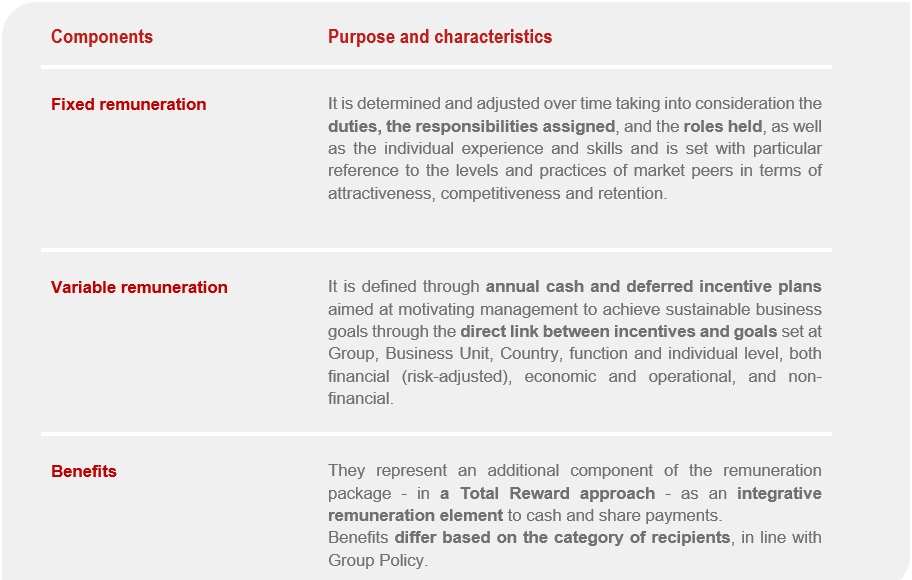
In particular:
- the remuneration package is clearly defined in order to guarantee a balance between fixed remuneration and variable remuneration, as well as to encourage the achievement of sustainable long-term results;
- the remuneration package is structured as a whole to ensure balance between the requirement to adequately incentivise the achievement of the best results in the interest of the Group and, at the same time, to guarantee, through the adoption of a series of precautions and safeguards, a healthy and prudent management, in accordance with the relevant regulatory framework;
- the “target” remuneration package is defined with the aim of maintaining a competitive level between median and upper quartile of the specific reference market, with the individual positioning linked to the evaluation of performance, potential, and strategic role, according to a segmented approach;
- variable remuneration is defined through annual cash and deferred share-based incentive plans, tied to individual and Group performance indicators, which also take into account the sustainability requirements, also in terms of the risks undertaken;
- the structures of the incentive plan provide access thresholds related to the Company's financial situation and risk management, as well as risk indicators and malus and clawback mechanisms and prohibitions on hedging;
- the expected performances are clearly defined through a structured and explicit system of performance management;
- the variable component (including an annual cash and a deferred in shares component) is as a whole:
- made up of at least 50% of shares;
- structured according to percentages and deferral periods differentiated by cluster of beneficiaries.

The Variable Remuneration
As in past years, the annual cash component of the variable remuneration consists in the so-called Short Term Incentive (STI), based on an annual performance assessment period and which provides for the payment of a cash remuneration upon the achievement of predefined goals.
The annual incentives system for the top management (excluding personnel belonging to Key Functions), aims at aligning the incentive with the actual performance of both individual recipients as well as the Group as a whole, through four rigorous process phases articulated in the definition of:
- the Group Bonus Pool, linked to the level of achievement of Group Normalised Adjusted Net Result and Group Operating Result and subject to prior verification of the Group Gate mechanism;
- Individual Performance, determined in accordance with predefined and measurable financial (risk-adjusted), economic and operational, and non-financial goals within the individual Balances Scorecards (BSC);
- the Individual Performance Calibration process in relation to the overall performance distribution, the reference context and compliance assessments;
- the Payout and individual cash allocation.
Generali's deferred variable remuneration consists in multi-year plans (so-called Long Term Incentive plan - LTI) approved from time to time by the competent bodies. Starting from 2019, the structure of the LTI plans provides for a share allocation system with deferral and lock-up periods over a time frame of 6-7 years, depending on the population of reference.
The 2026-2028 LTI plan has a structure and mechanisms that are consistent with those of the previous year, with revisions to the performance indicators, the related thresholds and target levels, and the percentage weight to reflect the reference context and are in alignment with and in support of the Group's strategy, specifically considering:
- maintaining the 3-year relative Total Shareholder Return (rTSR) (with a confirmed weight of 55%) as a fundamental indicator of performance for shareholders, confirming the threshold and target level for the allocation of shares starting from the median positioning with respect to the comparative insurance peer panel, to further link incentives to shareholders’ interests;
- maintaining the cumulative 3-year Net Holding Cash Flow (NHCF) (with a confirmed weight of 25%) as driver of the cash generation;
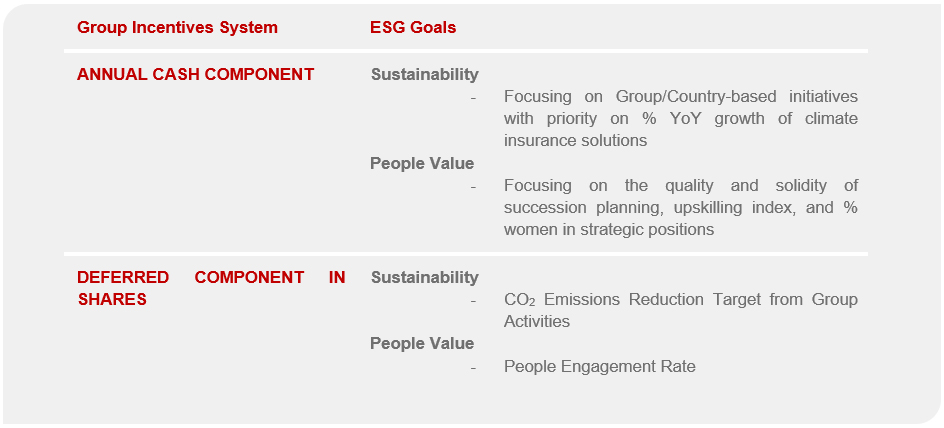
- maintaining internal and measurable ESG goals (with a confirmed weight of 20%) linked to the Generali Climate & People Strategy, with focus on:
- CO2 Emissions Reduction Target from Group Activities: underlining the strategic role of sustainability in every business action with the inclusion of enhanced targets in line with the Group’s commitment to Climate Strategy;
- People Engagement Rate: reaching and maintaining an Engagement Rate above the external market benchmark is one of the Group’s strategic commitments to the market and lies at the heart of our People Strategy, confirming how engaged People are the Group’s core asset to successfully deliver our Strategy and sustain our cultural and organisational transformation.
The remuneration of Heads and First Reporting Managers belonging to the Key Control Functions is structured in line with market practices and regulatory requirements.
Remuneration consists of fixed remuneration, a variable remuneration linked to participation in a specific deferred cash incentive plan, as well as additional benefits in line with the Group Policy.
Remuneration and Sustainable Performance
Sustainability for Generali
Our journey towards sustainability is rooted in the fundamental principle of embedding long-term value creation for all stakeholders and society at large. With the implementation of the Lifetime Partner 27: Driving Excellence strategy, Generali reaffirms its ambition to deliver profitable growth with a positive impact on people and the planet, while continuing to act as a responsible player. The aim is to strengthen its position with an enhanced sustainability value proposition. This will be supported by a range of updated targets focused on the green and just transition, as well as societal resilience. The Human Safety Net’s expertise will also be leveraged to assist the most vulnerable communities.
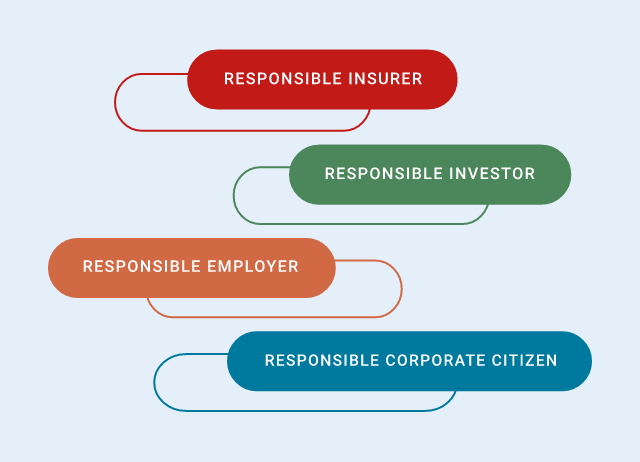
Generali stands firm in its role as a Responsible Insurer and Investor, weaving sustainability into the very fabric of our core business. As a Responsible Employer, we champion an inclusive workplace, prioritising the well-being and growth of our employees, while also committing to reducing greenhouse gas emissions from our own operations. This commitment is equally reflected in our role as a Responsible Corporate Citizen, where our engagement with communities reinforces our strategic intent. Underpinned by robust governance, comprehensive policies and guidelines, and reliable integrated reporting, our sustainability journey is both meaningful and accountable. The integration of sustainability into management remuneration is a key step in strengthening the link between company/individual performance and sustainability. This is made possible by drawing on a panel of strategic sustainability goals that reflect the priorities of the Lifetime Partner 27: Driving Excellence strategy.
Over the years, the commitments made and the results achieved by the Group have led to improved ratings from leading agencies specialising in sustainability performance analysis as well as to the Group's inclusion in key international sustainability indices. In particular, in October 2025 MSCI ESG reaffirmed Generali's "AAA" rating, the highest possible, for the fourth consecutive year. Moreover, Generali is included in the Dow Jones Best-in-Class World Index and in the Dow Jones Best-in-Class Europe Index.
Sustainability Goals in the Remuneration Policy
The alignment with the strategy and the creation of sustainable value is the founding principle of our Remuneration Policy to ensure sustainable performance in the short, medium, and long term in the interests of all stakeholders. Sustainability is a key market competitiveness factor, supporting Generali’s ability to attract, motivate and retain talent. It aims to go beyond economic and financial returns to become an integral part of the way we conduct business, enabling profitable growth with a positive impact on people and the planet.
In line with the Group's ambitions under the new strategic plan Lifetime Partner 27: Driving Excellence, and in continuity with 2025, the 2026 Remuneration Policy maintains its merit-based approach and multi-year horizon, integrating a combination of sustainable business goals with a direct link between incentives and results at the Group, Business Unit, Country, Function and individual level - both financial (risk-adjusted), economic and operational, and non-financial, which include specific performance indicators linked to internal and measurable sustainability goals.
The Group's 2026 incentives system aims to achieve real and long-lasting results, by setting an adequate risk assumption that is proportionate to the level of influence an individual has on the Group's results, while respecting stakeholders' interests, market best practices, and regulatory requirements. This system includes in the variable remuneration an annual cash component as well as a deferred share component with sustainability goals, and as a whole:
- is made up of at least 50% shares in alignment with strategic goals and stakeholder interests;
- is structured according to percentages with deferral and lock-up periods over a time frame of 6-7 years, depending on the reference population, in alignment with long-term sustainable value creation.
Gender Balance & Pay Equity
In line with the principles set out in the Group DEI Guideline, the Group ensures equal opportunities and fosters an inclusive working environment and, in particular, it continues to promote a culture grounded in gender balance and pay equity.
Since 2020, specific analyses have been carried out at local level using a Group-wide methodology focused on ensuring fairness in terms of the Equal Pay Gap for the same role or for roles of equal value.
During the 2022-2024 strategic cycle, the Group strengthened this approach by introducing a methodology based on statistical regression models, which considers the most relevant gender-neutral objective factors of salary differentiation (e.g. professional family, organisational level). This anticipated the direction of emerging regulatory developments and helped reinforce pay transparency across the organisation.
This methodology enabled consistent and data-driven analysis at Country and Business Unit level and allowed the Group to progressively reduce the Equal Pay Gap towards zero, with a specific focus on base salary. At the end of the 2022-2024 strategic cycle, Generali achieved the closure of the Equal Pay Gap, in line with the ambitious goals set at the beginning of the journey, confirming the effectiveness of the approach adopted.
Building on the progress made in previous years, in 2025 the Group embarked on a series of actions, as part of a process to refine its analytical framework and further expand its scope towards a broader total-remuneration perspective, with the aim of integrating additional components and objective criteria to provide an even more comprehensive view of pay equity, while maintaining a strong focus on monitoring and consolidating over time – from 2025 onwards - the results achieved in the 2022-2024 strategic cycle on the Equal Pay Gap with a result of 0.35% (within ± 1% reference threshold for zeroing Equal Pay Gap based on the most widely recognised market practices).
The Share Plan for Group Employees
We SHARE is Generali’s employee share plan designed to strengthen ownership, engagement, and participation in the Group’s sustainable value creation by offering employees the opportunity to purchase Generali shares at favourable conditions.
Discover more on the We SHARE page.
People Engagement & Caring
Generali fully acknowledges the importance of providing a working environment that addresses employee engagement, health, and well-being as an integral part of our organisational culture and identity.
The Group believes that people can achieve their full potential when they are engaged, believe in a common purpose, operate in an environment that nurtures their passion, and have the ambition to succeed in everything they do. From this perspective, Generali wants to be a workplace where everyone feels valued, included, and empowered to face the future at their best.
To strengthen its employees’ sense of belonging and connection, and make everyone feel supported and close to the organisation, the Group is committed to enhancing interaction through regular and active listening. The Listening Strategy supports the design and implementation of actions based on what matters most to employees.
Among the tools underpinning this approach, the Group leverages dedicated employee surveys, including the Generali Global Engagement Survey and the Global Pulse Survey. In addition, at European level, Generali’s top management regularly exchanges with European Works Council (EWC) delegates on local engagement initiatives, contributing to a structured and ongoing social dialogue on people-related topics.
The Generali Global Engagement Survey is conducted every three years and covers key dimensions of the work environment, including relationships with top management and line managers, career development, training, diversity, equity and inclusion, hybrid work models, well-being, empowerment and trust, and collaboration between teams and between departments. The Global Pulse Survey, introduced in 2022 to further strengthen the employee listening approach, adopts a shorter and more specific version of the questionnaire and is conducted annually in the periods between two editions of the Global Engagement Survey.
The Global Engagement Survey and the Global Pulse Survey are open to all employees and aim to measure and promote on a yearly basis employee engagement, a key element of the GPeople 27: People Powered Excellence Strategy. As part of the Group’s strategic commitments to the market, the People Strategy aims to maintain a People Engagement Rate above the external market benchmark, a target achieved in 2025, as confirmed by the Global Pulse Survey 2025, which achieved its highest ever engagement rate at 85%, with a record participation rate for a Pulse Survey of 89%.
The listening approach also supports the identification of trends and priority areas for improvement, such as ways of working, business processes, and internal tools. The goal is to streamline daily activities, improve overall working conditions, and increase opportunities for connection and feedback, while integrating employees’ perspectives into corporate processes and strategy development.
Each survey is followed by a detailed analysis of employee feedback to identify areas requiring improvement or acceleration, informing the development of targeted initiatives to make Generali an even better place to work. Feedback collected through the 2025 Global Pulse Survey confirmed the excellent work carried out in defining, planning, and executing the initiatives launched during the first year of the 2025–2027 strategic cycle. The results also reaffirmed the priorities identified in the 2024 Global Engagement Survey, highlighting significant progress, supported by more than 400 engagement initiatives active across the Group.
The consistently high participation rates reflect the Group’s attention to individual feedback and the concrete initiatives implemented in response to survey results. Through active listening, Generali seeks to ensure that engagement actions remain relevant and impactful over time.
Dedicated moments of sharing with the European Works Council (EWC) representatives are set at various stages along the overall process of implementation of the surveys and the related initiatives and actions. The fruitful and open dialogue with the European Works Council (EWC) represents for Generali a key element to support the transformation of our working model, characterised primarily by the adoption of a hybrid and balanced way of working. In this regard, we have engaged with the EWC in monitoring the application of the Joint Declaration on the New Sustainable Way of Working in a Next Normal Scenario, issued in February 2023. Trust, empowerment, and care for people are key elements highlighted in the declarations defined with the EWC over the years, alongside inclusion, equality, non-discrimination, and the right to disconnect - ensuring a balanced work-life setting for all employees.
Furthermore, with the the Joint Declaration on Technological Transformation, Digitalisation and Artificial Intelligence (AI), signed 17 December 2025, Generali and the EWC have set shared human‑centric principles for the responsible adoption of Artificial Intelligence, ensuring human oversight and supporting safer, fairer and more inclusive working conditions. In particular the Declaration promotes the use of technology to enhance job quality and wellbeing, reducing routine tasks, enabling higher value‑added work, and strengthening skills through upskilling and reskilling Initiatives.
Remuneration Policy for Non-Executive Directors and Members of the Supervisory Body
NON-EXECUTIVE DIRECTORS
The Remuneration Policy related to all Directors without executive powers - with the exception of the Chairman, whose remuneration is detailed below - provides that the remuneration is composed of three elements: a fixed annual fee, an attendance fee for each meeting of the Board of Directors where they participate, as well as reimbursement of expenses incurred for attending the meetings.
The Shareholders' Meeting of 24 April 2025 determined that, for the three-year period 2025-2027, each member of the Board of Directors is entitled to:
- a gross annual fixed remuneration of € 100,000, with an increase of 50% for the members of the Executive Committee, if established;
- an attendance fee of € 4,000 gross for each meeting of the Board of Directors and of the Executive Committee, if established;
- the reimbursement of out of pocket expenses incurred to attend meetings and perform other activities required by their office.
Directors who are also members of Board Committees are paid fees that are additional to those already received as members of the Board of Directors, with the exception of those who are also executives of the Generali Group. The remuneration is established by the Board of Directors pursuant to Article 2389, paragraph 3 of the Italian Civil Code according to both the powers assigned to these Committees and the commitment required for participation in their work in terms of number of meetings and preparatory activities.
Furthermore, in line with regulatory legislation and international market best practices, no variable remuneration is paid to non-executive directors.
The Remuneration Policy for the Chairman of the Board of Directors provides for the payment of a fixed annual remuneration determined based on comparative analyses with similar national and international figures. Like all Directors without executive powers, the Chairman does not participate in the short- and medium/long-term incentive plans. For this figure, the Remuneration Policy of Assicurazioni Generali also provides for the allocation of some benefits such as, for example, insurance coverage for death and total permanent disability from injury or illness, as well as health care and the availability of Company car with driver and for mixed use.
SUPERVISORY BODY
For these parties, the Policy provides for the payment of an annual fixed gross remuneration for the entire duration of the mandate, with an increase of the amount for the Chair of the Board of Statutory Auditors considering the related coordination activities. The members of the Board of Statutory Auditors may be granted an attendance fee for participating in meetings of the Board of Directors and Board Committees. There are no variable remuneration components.
The remuneration levels of the members of the Control Body are defined taking into account, among other things, the reference benchmark and the size/complexity of the Company.
The Annual General Meeting of 23 April 2026 approved the remuneration to be paid to the Board of Statutory Auditors, deciding for the remuneration payable to the Statutory Auditors at € 130,000 gross per year, for each of the financial years 2026, 2027 and 2028 and € 180,000 gross per year for the Chair of the Board of Statutory Auditors considering the related coordination activities. Moreover, the members of the Board of Statutory Auditors receive an attendance fee of € 500 for participating in meetings of the Board of Directors and Board Committees.
The members of the Body are reimbursed for expenses incurred while exercising their functions and the coverages of the D&O insurance policy as illustrated below.
For more details about the remuneration tables of the Administrative and Control Bodies, General Managers and other Managers with Strategic Responsibilities, click here.
Download Documents
2026