
Generali Trustworthy AI
We want to earn full Digital Trust from our customers by ensuring responsible use of data and algorithms, leading to a sustainable competitive advantage and a stronger lifetime partner relationship.
Generali Trustworthy AI principles
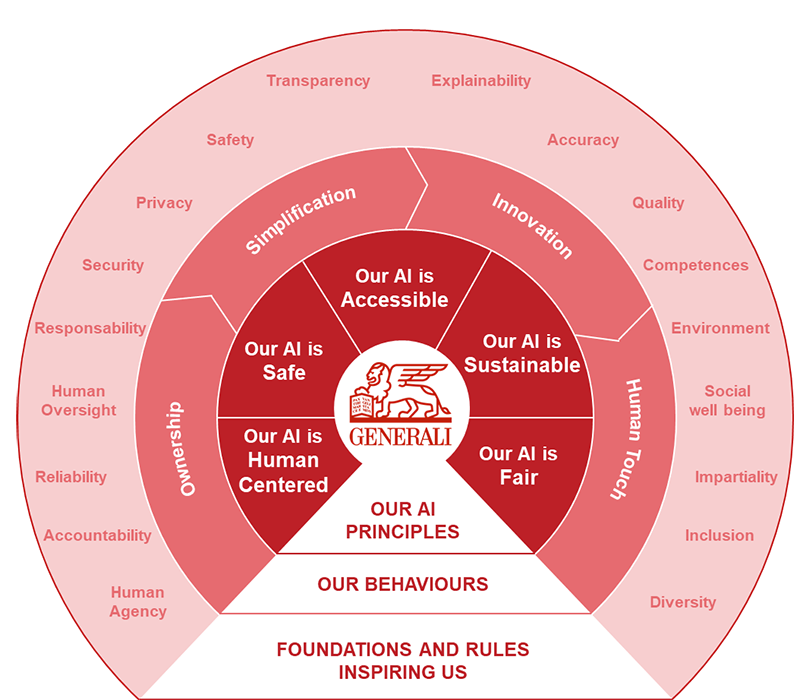
Generali’s Trustworthy AI is a unique combination of our corporate values and ethical principles inspiring us
Our AI is...
AI Ethics Framework
PRINCIPLES
Generali Trustworthy AI key principles represent our unique combination of corporate behaviors and foundational values related to Artificial intelligence inspiring us
RULES AND STANDARDS
To concretely adopt high ethical approaches on data and algorithms we developed a set of rules and standards inspired by our Trustworthy AI key principles
COMMUNICATION & AWARENESS
To engage our stakeholders on our approach toward Trustworthy AI we plan for the communication and awareness diffusion of our key principles
TRAINING
To promote an appropriate application of our responsible approach to AI we train our people to know our key principles and to recognize ethical dilemmas related to new technologies
GOVERNANCE
To monitor and support the implementation of our principles and rules we supervise the application of AI and we define best practices
INTERNAL REGULATION
Since 2023, Generali has had in place a mandatory internal regulation on Artificial Intelligence, adopted by the executive management, establishing a comprehensive governance framework and a standardized approach for managing AI systems throughout their entire lifecycle.
It addresses key principles such as protecting data privacy when developing or using AI, safeguarding cybersecurity, preventing bias and discrimination, maintaining appropriate human oversight of critical decisions, ensuring transparency and explainability of AI systems and their outputs, assigning clear accountability for AI-generated outcomes, and defining explicit boundaries regarding what AI systems can and cannot do.
The framework also promotes fairness, interpretability, compliance, and security through dedicated assessment, monitoring, and risk management processes. In addition, the Group continuously works to strengthen its AI governance capabilities by implementing mechanisms to detect and address potential model drift or performance degradation over time, as well as by carrying out periodic assessments of deployed AI models to monitor fairness and identify potential bias.
Following the entry into force of the EU AI Act, the internal regulation has been further enhanced to incorporate the new regulatory requirements, including the explicit prohibition of AI systems that engage in manipulative practices, exploit individuals’ vulnerabilities, perform social scoring, or enable unauthorized biometric surveillance, in line with the prohibited AI practices defined by the Regulation.
The framework reflects the full implementation of the regulation in force from time to time.