
Europe’s Reckoning
The United States may be transitioning from being an ally to being an adversary, and Europe’s leaders seem to have no plan for how to handle this new era
THE CONTEXT
What happens if the United States and Europe no longer share the same objectives? The lesson of Charles de Gaulle.
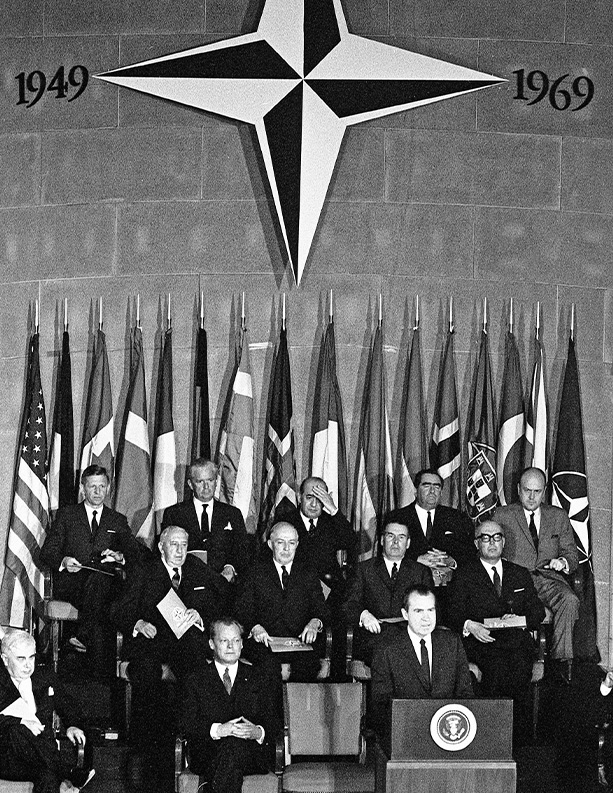
For nearly eight decades, Europe has lived under the assumption that American protection was eternal. In 1948 the creation of the Marshall Plan, which established economic dominance, and NATO, which established military dominance, allowed Western Europe’s shattered states to rebuild behind a shield of American power. The US supplied not only security, but also markets, investment, and a vision of a liberal order. America’s control over countries on the West side of the Iron Curtain may have been less obvious than the Soviet control to the East, but it shared many of the same characteristics. The Cold War had locked Europe into dependent relatonships with the Soviet Union on one side and the United States on the other.
After the Berlin Wall fell, the Soviet hold over the East collapsed. The European Union was created in 1992 in an effort to make Europe a sovereign economic power. But no effort was made to give Europe military sovereignty. Instead, the American protectorate was deepened and extended from West to East. The US interventions in the Balkans in the 1990s and the joint missions in Iraq and Afghanistan reinforced a sense of permanence to the American dominance.
Generations of Europeans came to see this protectorate as a constant. Washington would handle the hard power, while Europe could specialize in diplomacy, welfare states, and economic integration. Throughout these decades, only one leader dared to suggest that America’s commitment might be contingent – French President Charles de Gaulle. He warned of America’s growing power over Western Europe and the increasing inability for Europe to act independently. It was for this reason that he took France out of NATO’s command structure in the 1960s, to ensure that France developed an independent military deterrence unlike the United Kingdom. For years, De Gaulle was ridiculed by Europe’s dominant Atlanticist establishment, and the French perspective on this issue was seen as self-interest or an anti-American reflex. Now, in the cold hard light of 2025, we can see that de Gaulle was right, and the Atlanticist establishment that has been in charge in Europe all of this time was wrong.

Europeans have long lived under the belief that American protection was guaranteed forever. Only Charles de Gaulle questioned it
A new world
Even before Trump’s unrestrained second term began in January of this year, there had long been signs that the values and strategic priorities of America and Europe were diverging. The US has been increasingly focused on Asia and domestic polarisation, while Europe remains preoccupied with its neighborhood and energy vulnerabilities. The Obama administation was already warning Europeans about this 15 years go, with Defence Secreatary Bob Gates telling European defence ministers in 2011: “The blunt reality is that there will be dwindling appetite and patience in the US Congress, and in the American body politic writ large, to expend increasingly precious funds on behalf of nations that are apparently unwilling to devote the necessary resources or make the necessary changes to be serious and capable partners in their own defense.”
Values have been diverging too - on climate policy, regulation of technology, approaches to China, freedom of speech, democracy and the rule of law. The American domestic political situation has grown increasingly violent, as was evidenced by the insurrection in January 2021. To many, it seems like the US is hurtling toward either full-blown authoritarianism or civil war. Europe may have its challenges with a rising far right and citizen discontent, but its political situation is a bastion of stability compared to America’s. The problem is that Europe’s dependence on the US means that stability could rapidly crumble if the United States falls into domestic chaos, or if the United States becomes a military adversary of Europe. If, as Trump has suggested in the past, the United States invaded Denmark or sided with Putin in a Russian invasion of the EU, there is little ability for Europe to resist, and there is no contingency plan.
In a world in which the US becomes disinterested in or adversarial toward Europe, the continent’s entire strategic foundation needs to be rethought. Europe needs its own credible military deterrent, something it has historically resisted. This would mean pooling resources, investing in defense industries, and establishing an independent European nuclear umbrella over the continent. Though these conversations have been taking place since Russia’s 2022 invasion of Ukraine, Europe is not moving toward these strategic autonomy goals in any meaningful way. Europe’s leaders are still placing all their trust in NATO, and they are still resisting efforts to build an EU capability for defence for fear of undermining NATO.
A break with the US would also require Europe to secure energy independence through renewables, nuclear expansion and diversified partnerships. Europe would need to accelerate its own innovation ecosystems, reducing dependence on US tech giants and supply chains. Europe would also need to challenge American control over the world’s financial infrastructure. The dollar’s dominance in global markets gives Washington extraordinary leverage. Europe would need to elevate the euro, or a new financial instrument, as a true global reserve alternative.
Europe chooses subservience
But this is not the path European leaders have chosen. Instead, they have kept their heads down and tried to flatter and ingratiate themselves to Donald Trump, further cementing the vassal-like relationship that Europe has with America. Leaders commited to a 5% of GDP spending target at NATO in June, a nonsensical number that even the US doesn’t reach. Because it has not been accompanied by a plan to develop independent European command and control over European defence, spending this money within the US-controlled NATO command and control structure and commiting to using it to buy American weapons will not actually improve Europe’s ability to defend itself without the Americans. Then came the EU’s one-sided “trade deal” with Trump, a clear surrender to the US president’s extortion. The deal was done in the hopes of avoiding a trade war and keeping the US commited to NATO and Ukraine, as the European Commission’s trade director-general Sabine Weyand admitted at an event in Austria in August. If the EU didn’t give in, the US would “abandon the security partnership with the EU” she said, noting that the world is “more power-based than rules-based at the moment.”
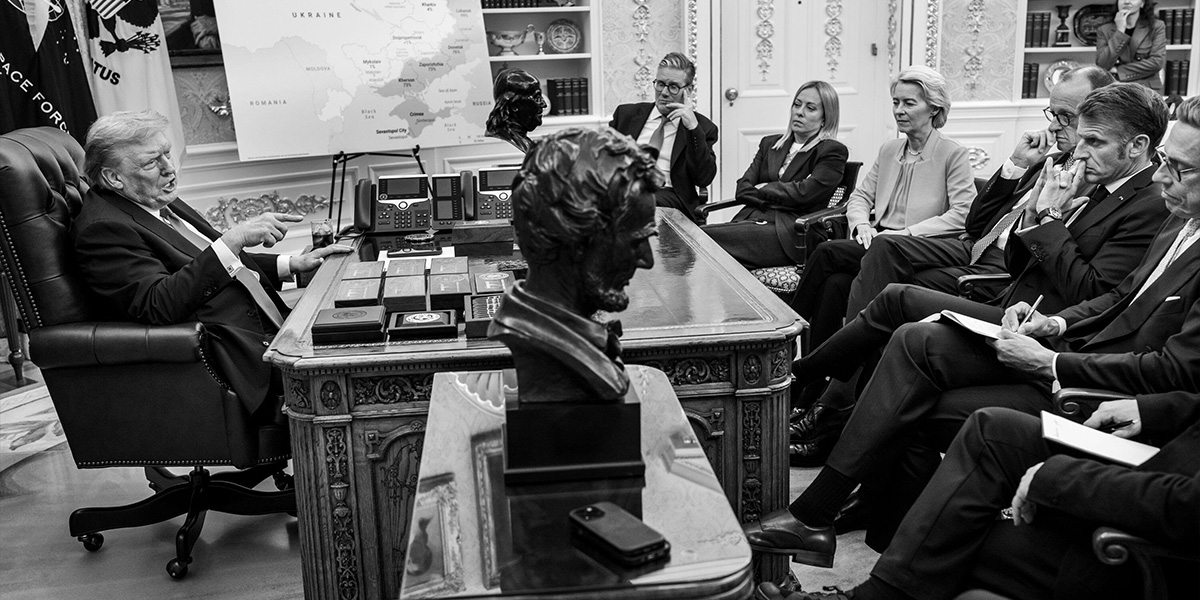
Europeans have been treated to the humiliating spectacle this summer of their leaders calling Trump “daddy”, lining up like schoolchildren in front of his oval office desk in Washington in August as they pleaded with him not to collude with Vladimir Putin to force Ukraine to cede territory to Russia. “When Trump returned to the White House, European leaders seemed unconvinced as to how to handle him,” wrote the Financial Times in an August editorial. “By now, their strategic choice is evident. It is accommodation rather than confrontation, accompanied by flattering rhetoric noisily praising Trump’s peace- and dealmaking prowess. The question is whether the loss in self-respect has been worth it. Note what these choices have cost Europe. It has shed all the political capital it could have mobilised to lead a coalition of countries in defence of rules-based trade and a concerted opposition to Trump.”
Mario Draghi, the former European Central Bank chief and Italian prime minister, has been outspoken in his criticism of the path European leaders have chosen to go down this summer. In a speech in Rimini at the end of August, Draghi called the recent developments, “a very brutal wake-up call” for Europe. “For years, the European Union believed that its economic size, with 450 million consumers, brought with it geopolitical power and influence in international trade relations. This year will be remembered as the year in which this illusion evaporated.”
NUMBERS
5%
of GDP: it is the military spending decided at the NATO summit.
€800bln
Money mobilized through ReArm Europe plan.
19%
Increase in EU states’ defense spending 2023-2024.
The cost of inaction
If Europe cannot change in time, the consequences would be destabilising. Eastern EU states could be left defenseless, leading to renewed Russian influence or territorial aggression. Sanctions, tariffs or US-dominated supply chains could marginalise European industries. Without a unifying protector, divisions within the EU could widen, fueling nationalism and separatism. Nobody knows if the peace and unity this continent has enjoyed can survive the loss of the American protectorate. The worst-case scenario would be a return to the kind of fractured, insecure continent that twice descended into war in the 20th century.
For Europeans, the collapse of the transatlantic bond would not just be a matter of geopolitics, it would be felt in daily life. Energy shocks, trade disruptions, and defense spending will all raise household expenses. Travel, visas, and digital services linked to the US could become restricted. Media, entertainment, and education systems long shaped by US influence might fragment, accelerating the search for a distinct European cultural identity.
Alberto Alemanno, a Democracy Fellow at Harvard, has argued that European citizens are aware of these risks but their leaders are stuck in inertia. “From Helsinki to Lisbon, people are suddenly experiencing the same existential unease,” he wrote in The Guardian. “More and more Europeans now recognise that their small, individual nations cannot withstand simultaneous pressure from both Washington and Moscow.” Partly because of these threats, support for EU membership is now at the highest level recorded – 74% according to the most recent Eruobarometre survey. “This is a historic opportunity. And yet, EU and national leaders remain paralysed - unable, or unwilling, to convert this public support and shared urgency into political momentum for reducing Europe’s dependence on US military guarantees and economic shelter.”

Two paths
Europeans now face a choice in how to respond to the American threats. The path that their leaders have chosen over the past months has been to try to deescalate the situation and placate the US president. They have calculated that the costs of a conflict with Washington would be too high. This has been generously interpreted by some as a “buying time” strategy, acquiescing to American demands for now while Europe builds independence. The words of European leaders might give the impression that they are doing something to reach this goal. Italian Prime Minister Giorgia Meloni warned that the EU “risks geopolitical irrelevance” and that “returning to prominence in history will be neither easy nor free.” German Chancellor Friedrich Merz has said that Europe must urgently “achieve independence from the USA”. European Commission President Ursula von der Leyen said in April “the West as we knew it no longer exists.”
Yet the urgency of these leaders’ words have not been matched with action. There are no real efforts to build sovereign EU defence, no real efforts to reduce the dollar’s dominance, no real efforts to de-risk Europe’s relationship with America. Von der Leyen has in fact explicitly ruled out pursuing the same de-risking strategy with the US as she is pursuing with China. In her agreement with Trump she has already promised to adjust four pieces of EU legislation to make the Americans happy: three on climate and one on vehicle safety standards. Whether or not that legislation will actually be adjusted, by making the promise she has conceded that Trump gets a veto on EU legislation.
The defenders of this summer’s actions say that these EU promises are not real, they are simply meant to placate Trump while the EU prepares its defences. But this appeasement path is frought with peril. For one thing, it does not seem to be working. Just weeks after the deal, Donald Trump is back to threatening the EU with tariffs if it doesn’t adjust its digital laws to suit American interests. But perhaps even more importantly, as the Financial Times pointed out: “Europe is risking its political soul. It has put itself in a situation in which leaders cannot say publicly what they are actually trying to do. That is a recipe for distrust and a poison for democracy.”
The other path is not appeasement, but standing up to Trump now and making it clear that Europe is a single market equal to the United States and should be treated as such. This path also comes with risks. Trump could respond by tossing Ukraine to the Russian wolves, pulling out of NATO, and declaring a full-blown trade war against the EU. But a look at the global powers that have defied Trump, such as China, India and Brazil, shows that the US president may be more bark than bite. They did not surrender, and they have not yet suffered major consequences.
In the end, the shock of a full-blown trade war with the United States may be the only thing that can spur Europeans into action. Because while politicians may claim they are “buying time” by appeasing Trump now, the reality is that nothing is happening behind the scenes. The appeasement path will result in continued subservience, with Europeans adjusting their laws to suit American demands in exchange for a security guarantee that may be illusory anyway. Even if European countries behave as the perfect vassal states, Trump may abandon them anyway in the event of a Russian invasion. As Meloni said, a path to European sovereignty and self-reliance will not be painless and it will not be free. That’s why she and the other leaders aren’t yet doing it. Europeans need to have an honest conversation about what kind of future they want, because keeping things the way they have been for the past decades is no longer an option.

David Keating
American journalist, currently Brussels correspondent for France 24. He was formerly the editor of EuropeanVoice.com. In 2023, he ranked first among influencers on European affairs.