
Europe at the Crossroads: Building Independence in a Changing World
Europe’s challenge is independence in the sense of resilience. This means the ability to adapt, ensure its own security, sustain its economies, and innovate technologically.

THE CONTEXT
The article analyzes Europe’s challenges in achieving independence in defense, technology, and the economy, while putting forward some proposals.
From Interdependence to Uncertainty
For decades, the European project thrived on the promise of interdependence. Security was guaranteed through NATO and, above all, the transatlantic partnership with the United States. Technological innovation was imported, adapted, and regulated rather than domestically generated. Energy was supplied by relatively cheap imports from Russia and the Middle East. This model allowed European governments to pool sovereignty within the EU, provide stability and prosperity at home, and position Europe as a “normative power” in world politics.
Today, this model is under strain. Russia’s war against Ukraine, intensifying geopolitical competition between the US and China, the weaponization of energy flows, and disruptive technologies such as AI and quantum computing all expose Europe’s vulnerabilities. Mario Draghi, in his recent Rimini speech, underscored how Europe faces an urgent need to move from complacency to capability, from assuming that others will provide to equipping itself to act.
In what follows, I will argue that Europe’s challenge is not independence in the absolute sense, no advanced economy can be fully self-sufficient, but independence in the sense of resilience: the ability to adapt, to secure itself, to power its economies, and to innovate technologically without being unduly dependent on actors who may not share its interests. To achieve this, Europe has instruments at hand, but using them requires political courage, institutional adaptation, and above all leadership that can frame independence as a common European project rather than a zero-sum national contest.
Security: From Shielded to Shoulder-to-Shoulder
European security has long been shielded by the American guarantee. The US provided the bulk of NATO’s capabilities, from intelligence and logistics to nuclear deterrence. But as American politics grows more polarized, and as Washington increasingly focuses on its rivalry with China, Europeans can no longer take for granted that their security will always remain Washington’s top priority. The prospect of a US administration less committed to NATO than in the past makes this clear.
This shifting context should not be read as a call to decouple from the US. On the contrary, NATO remains indispensable, and American power continues to underpin Europe’s defense. But Europe must be able to make its own choices. That means investing more seriously in defense capabilities, in readiness, and in shared procurement. At present, European defense markets remain fragmented, with 27 different systems and procurement strategies. Pooling demand, through the European Defence Fund and coordinated NATO initiatives, would not only yield efficiency but also enhance credibility.
The EU already possesses instruments: the Permanent Structured Cooperation (PESCO) framework, the European Peace Facility that supports arms deliveries to Ukraine, and the nascent debate on joint borrowing for defense. Yet the scale of investment required demands more than modest coordination; it requires leadership willing to tell voters that defense spending is not a diversion from social priorities but a precondition for protecting them. Here the shift in US policy is paradoxically an opportunity: precisely because the American commitment can no longer be assumed, European publics and leaders are more open to the idea that Europe must do more for its own defense.
Technology: From Regulation to Innovation
Europe is rightly proud of being a regulatory superpower. From the General Data Protection Regulation (GDPR) to the forthcoming AI Act, EU rules shape not only European markets but global ones. Yet regulation without innovation risks leaving Europe dependent on others’ technologies.
Today, most of the cutting-edge digital platforms are American, while China is rapidly catching up in critical areas such as AI and quantum. Europe excels in scientific research and has world-class universities and researchers, but struggles to translate this knowledge into scalable technologies. Venture capital markets are fragmented, start-ups often move abroad once they need to scale, and the EU’s single market remains incomplete in key sectors, especially services.
The instruments to address this exist. Horizon Europe provides significant funding for research and innovation. The European Innovation Council is designed to scale promising technologies. The EU Chips Act aims to secure semiconductor supply chains, while initiatives on cloud computing and digital infrastructure seek to reduce dependence. But scale and speed are lacking. Draghi’s Rimini speech highlighted the need for a leap in European investment capacity, comparable to what the US Inflation Reduction Act and China’s industrial strategies represent. That implies mobilizing not only EU funds but also private capital, which in turn requires deeper integration of Europe’s capital markets.
Independence in technology does not mean Europe must replicate everything the US or China produces. But it does mean developing sovereign capabilities in key areas where dependency could prove dangerous: semiconductors, AI, green technologies, and cybersecurity. Here, cooperation across borders is indispensable. No single European country can compete alone. A truly integrated digital single market and coordinated industrial policy are prerequisites for Europe’s technological independence. And this, too, requires leadership: not the temptation to nationalize successes, but the willingness to Europeanize them.
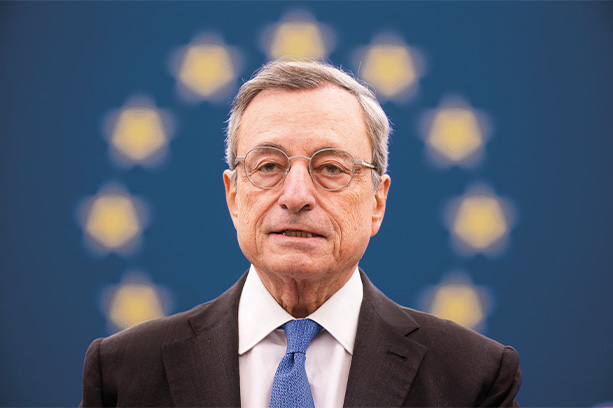
Mario Draghi’s speech in Rimini highlighted the need for a major leap forward in Europe’s investment capacity
Energy: From Dependency to Diversification
Perhaps no area illustrates Europe’s vulnerability more starkly than energy. Before Russia’s full-scale invasion of Ukraine, around 40 percent of the EU’s natural gas came from Russia. When Moscow weaponized these flows, Europeans faced soaring prices, inflationary pressures, and political discontent. Rapid diversification, towards LNG imports from the US and Qatar, pipeline gas from Norway, and accelerated renewables, helped avoid the worst-case scenarios. But the lesson is clear: overreliance on a single supplier can quickly turn into a strategic liability.
Energy independence, again, is not about autarky but about diversification and decarbonization. The European Green Deal provides the framework for reducing fossil fuel reliance and scaling up renewables. REPowerEU mobilized joint purchases and investment to secure alternatives. Yet bottlenecks remain: insufficient interconnection of grids, slow permitting for renewables, and uneven distribution of the costs of transition across member states and households.
The instruments are on the table: NextGenerationEU funds that support green investment, the Innovation Fund for clean technologies, and the Emissions Trading System that provides revenues for further decarbonization.
The question is whether Europe can accelerate implementation and ensure fairness. If citizens associate the green transition with rising costs and declining competitiveness, support will erode. Here again, leadership is crucial. Leaders must craft a narrative of fairness: that the transition is not only about planetary responsibility, but also about cheaper energy bills, new jobs, and greater resilience.
Risks and Opportunities
Whether through political polarization or a strategic pivot to Asia, American policy is shifting. For Europe, this is a source of risk: security guarantees may weaken, trade disputes may grow, and industrial competition may intensify. But it is also a source of opportunity. Precisely because the US is less able or willing to carry Europe’s burdens, Europeans have both the necessity and the legitimacy to do more themselves.
In security, that means building capabilities that complement NATO. In technology, it means not just regulating US platforms but fostering European champions. In energy, it means investing in renewables and grids rather than shifting dependency from Russia to American LNG. And in geopolitics, it means engaging with partners in Africa, Latin America, and Asia on terms that reflect European interests and values.
The EU has a track record of moving forward in crises: the euro after the financial crash, common borrowing after the pandemic, energy diversification after Ukraine. The question is whether it can once again turn vulnerability into momentum. That requires not only instruments, but leadership that can seize a window of opportunity and articulate a common purpose to European citizens.
AN IN-DEPTH LOOK
What Draghi Said
On August 22, 2025, during the Meeting of Communion and Liberation in Rimini, Mario Draghi urged Europe’s leaders: “We can change the trajectory of our continent. Turn your skepticism into action, make your voices heard. The European Union is, above all, a mechanism to achieve the goals shared by its citizens. It is our best opportunity for a future of peace, security, and independence.”Instruments: From Potential to Practice
Summarizing, Europe has at least five instruments at its disposal:
- Joint financing: from Eurobonds to potential defense borrowing, providing scale and solidarity.
- Market integration: completing the single market in services, energy, and digital sectors to enable scale.
- Industrial policy: targeted support for key sectors, from semiconductors to green technologies.
- Regulatory power: setting standards that align innovation with European values.
- External partnerships: diversifying suppliers and allies beyond the transatlantic frame.
What is missing is not the toolkit, but the leadership to deploy it strategically, to prioritize long-term resilience over short-term electoral comfort. Leadership means making choices: where to invest, what to sacrifice, and how to explain those decisions to citizens. Without this, even the best-designed instruments will remain underused.
Conclusion: Independence as Resilience
Europe’s future will not be written by nostalgia for past models of interdependence. It will be shaped by whether Europeans can forge a form of independence that is neither isolationist nor complacent, but resilient. Security, technology, and energy are the arenas where this resilience must be built. The US shift from guarantor to partner makes this urgent, but also possible.
The challenge is formidable. Yet Europe has the resources, the instruments, and the legacy of innovation under pressure. What it needs is leadership: leaders who are willing to tell uncomfortable truths, to mobilize publics for long-term goals, and to act decisively when crises demand it.
Independence in the 21st century does not mean standing alone. It means being able to stand firmly with allies, while retaining the capacity to act when others do not. Delivering that vision will demand leadership, of the kind that unites publics around a shared purpose, dares to take risks, and is willing to explain that Europe’s strength lies in doing hard things together. That is the essence of sovereignty, and it is Europe’s task for the decade ahead.

Catherine E. de Vries
Dutch political scientist, she is a professor of Political Science and chair of the Department of Politics and International Relations at IE University in Madrid. She previously taught for many years at Bocconi University in Milan.