
Generali at London Climate Action Week 2026: advancing resilience in the global climate agenda
From data and prevention to risk reduction: how insurers are helping shape a more resilient transition
At London Climate Action Week 2026 (LCAW), Generali contributed to the global discussion on how to turn climate ambition into action, with a growing focus on resilience, prevention and risk reduction.
Through its participation in high-level forums, the Group highlighted the evolving role of insurance: not only as a mechanism to absorb shocks, but as a lever to anticipate and reduce them.
Setting the direction of climate action
Held in London from June 20th to 28th, LCAW gathered over 75,000 participants across more than 1,000 events, bringing together institutions, businesses, and experts to accelerate the transition to a net-zero and resilient future.
In 2026, resilience moved to the centre of the debate, with a strong focus on implementation. Generali contributed through its participation in key moments such as the Climate Innovation Forum and the UNEP FI Global Round Table.
Resilience by design
Generali’s contribution addressed a structural gap: resilience is widely recognised, but still not systematically embedded into economic and financial systems.
Speaking across two high-level panels, Generali Chief Sustainability Officer Lucia Silva focused on what is needed to close this gap.
Embedding resilience into decision-making
At the Climate Innovation Forum panel, “Resilient by Design: Embedding Resilience at the Heart of Climate Action,” Silva underscored the critical link between ambition and execution: it is not enough to better understand risks; they must also be fully integrated into business and investment decisions.
Resilience is still too often treated as a downstream adjustment rather than a design principle. This also means recognising that resilience is not only a technical or financial challenge, but a societal one: while climate adaptation is crucial, it cannot be effective without strong, inclusive and adaptable societies able to support and sustain it.
Closing this gap requires a more integrated approach, bringing together data, prevention and collaboration across stakeholders. Existing models such as SME risk tools and public-private partnerships demonstrate how integrating these elements can reduce exposure and improve long-term outcomes.
This approach is reflected in initiatives like SME EnterPRIZE, which promotes a culture of sustainability among European small and medium-sized enterprises to strengthen their resilience, while promoting a broader culture of risk awareness.
The challenge now is scale - embedding resilience into financial decision-making and aligning incentives to reward both decarbonisation and risk reduction.
Financing resilience, not just growth
At the UNEP FI Global Round Table panel “From Risk to Resilience: Financing the Future,” the focus shifted to capital allocation. Silva stressed that financing the transition must go beyond supporting growth or decarbonization, to enable adaptation and long-term resilience.
This shift is expanding the role of insurers, from pricing risk to helping reduce it through data, innovation and partnerships.
This includes collaboration with international organisations such as the United Nations Development Programme (UNDP), alongside broader engagement with institutions like the Insurance Development Forum and UNIDO.





Turning resilience into action: Generali’s Climate Hub
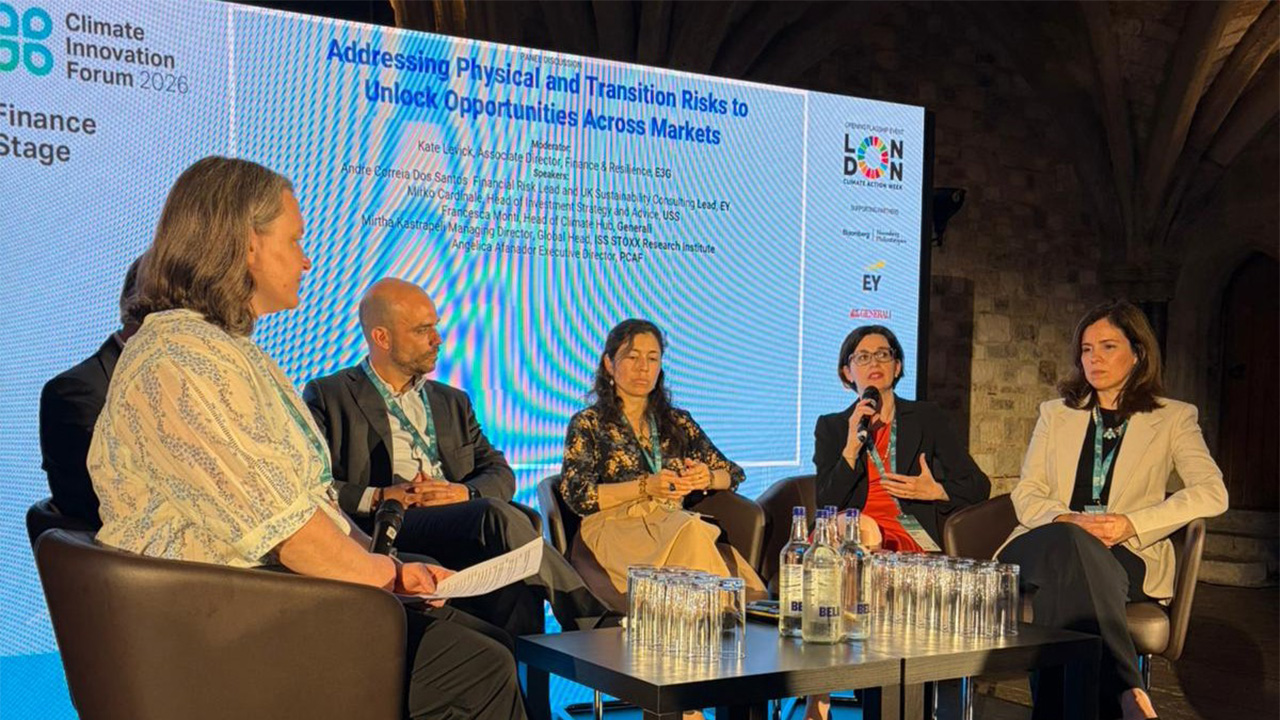
Francesca Monti, Group Head of the Generali Climate Hub, focused on how this shift is already taking shape in practice.
Climate risk is no longer a forward-looking scenario, but a present and structural challenge. In this context, insurers are expected to go beyond risk transfer and turn risk knowledge into actionable decisions. This is the role of Generali’s Climate Hub, which centralises climate expertise to assess exposure, model risks and support loss prevention strategies.
This is possible thanks to three enablers: data analysis, risk assessment and partnerships, reflecting how the Climate Hub translates knowledge into action.
Advances in data and AI are accelerating this process, enabling more granular risk assessment (from portfolio level down to individual assets) while improving underwriting and claims management.
From modelling to prevention
The next step is acting on this knowledge: reducing exposure before losses occur.
Concrete examples include tools like Geoya, the climate risk prevention platform that translates risk data into targeted mitigation measures at property level.
Partnerships to scale impact
Scaling this approach requires collaboration across sectors. Monti pointed to partnerships such as the one with the European Centre for Medium-Range Weather Forecasts (ECMWF), which combines advanced climate data with insurance expertise to improve risk understanding and support more effective decision-making.
The direction is clear: insurers are increasingly contributing to prevention and resilience, not only to post-event protection.
Where the transition becomes real
What emerged from London Climate Action Week 2026 is that resilience can no longer be treated as an add-on to the transition: it is becoming a condition for the transition itself.
For Generali, this means working on two fronts: contributing to frameworks and incentives that embed resilience into decision making, while translating risk knowledge into concrete tools, data and solutions for the real economy.
Connecting these two levels - strategy and execution - is where this evolution in the role of insurers becomes tangible. Not only to protect against risk, but to help shape how risk is understood, managed and ultimately reduced.
This is where the transition moves from ambition to reality.